
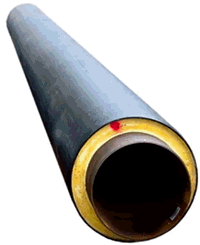
Insulation stress analysis is performed for straight pipes, bends, and tees with polyurethane insulation in buried elements according to EN 13941, EN 253, and GOST 55596 standards.

Strength assessment is based on equivalent and shear stresses acting along and perpendicular to the pipe axis. For detailed information, see Polyurethane (PUR) Insulation Stress Analysis.
When strength conditions are not met, the corresponding table cell highlights in red, and the notes column displays an error code. Hover over the code to view the error message. In printed reports, error and warning messages appear below the table. When all conditions are satisfied, the notes column remains empty.
Property |
Description |
Circumferential shear stress |
Circumferential shear stress τxy due to overlying backfill soil pressure. See Polyurethane (PUR) Insulation Stress Analysis |
Allowable circumferential shear stress |
Allowable circumferential shear stress |
Longitudinal shear stress |
Longitudinal shear stress τyz along pipe axis due to pipe-soil friction during thermal expansion. See Polyurethane (PUR) Insulation Stress Analysis |
Allowable longitudinal shear stress |
Allowable longitudinal shear stress |
Equivalent stress |
Equivalent stress. See Polyurethane (PUR) Insulation Stress Analysis |
Allowable stress |
Allowable stress |
No. |
Note |
Description |
N287 |
Shear stress exceeds allowable |
Shear stress in insulation exceeds allowable limit |
N290 |
Equivalent stress exceeds allowable |
Equivalent stress in insulation exceeds allowable limit. Reduce burial depth to resolve. |
N289 |
Pipeline loads from soil pressure must be removed |
Pipe wall stability lost under surrounding soil pressure, typically in vacuum elements. Increase wall thickness, reduce burial depth, or decrease soil weight to resolve. |
After analysis: Output > Insulation Stress