
PASS/START-PROF uses a right-handed coordinate system. The Y-axis is generated by rotating the X-axis 90 degrees counterclockwise when viewed from the positive Z-axis direction. The global Z-axis always points upward. Gravity acts downward along the negative Z-axis (Figure 1).
All forces and linear displacements are defined as projections onto the global coordinate axes (X, Y, Z). Positive directions align with the axes directions. Rotation angles and moments are positive when counterclockwise about their respective axes.
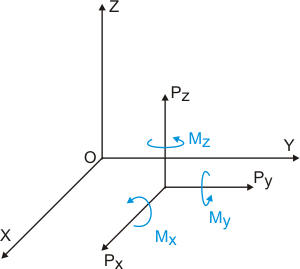
Figure 1. Global coordinate system in PASS/START-PROF showing positive directions for forces, moments, displacements, and rotations
Support loads, node displacements, expansion joint deformations, and internal forces can be modeled in local coordinates (Xm, Ym, Zm) aligned with element axes (Figure 2).
The local Xm-axis follows the pipe element axis from start node to end node. The Zm-axis is perpendicular to the element axis and lies in the vertical plane, with an angle of 90° or less between the global Z-axis and local Zm-axis (Figure 2a). The Ym-axis completes the right-handed triad. For vertical elements, Xm aligns with the Z-axis, Ym with the X-axis, and Zm with the Y-axis (Figure 2b).
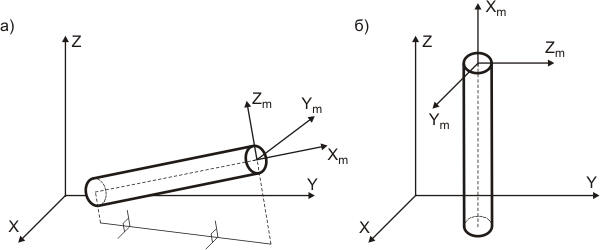
Figure 2. Global coordinate system (X, Y, Z) and local element coordinate system (Xm, Ym, Zm)
Support coordinate axes are defined as follows:
Axial - follows the pipe axis projection on the horizontal plane (Xmm)
Transverse - perpendicular to the pipe axis in the horizontal plane (Ymm)
Vertical (Zmm)
Note: Pipe local coordinate axes do not align with the local axes of adjacent elements. Pipe axes remain fixed in horizontal and vertical planes regardless of pipe slope.
