
START-PROF provides multiple methods for flange leakage evaluation:
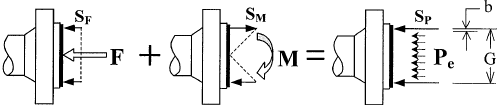
Conservative method converting axial force and bending moment into equivalent pressure:

F - Axial force
on flange
M - Bending moment on flange
G - Effective gasket diameter
Prating - Allowable flange pressure from rating standards
(ASME B16.5, EN 1092, GOST)
Test condition allowable pressure factors: ASME B31.1: 1.15, ASME B31.9: 1.2, ASME B31.3: 1.33, ASME B31.4: 1.15, ASME B31.5: 1.33, ASME B31.8: 1.11, EN 13480: 1.3
Less conservative method based on research by Dr. Warren Brown, adopted in ASME Code Case 2901 (2017).

Equivalent form:

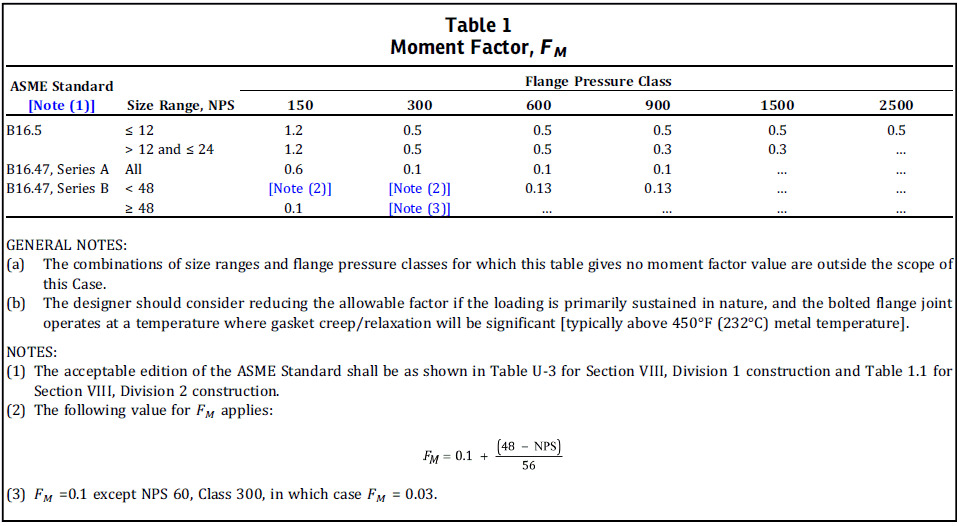
Uses Fm factor from standard tables to increase allowable pressure.
Increases allowable pressure to hydrotest levels with 1.3 safety factor.

Equivalent form:

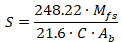
For high-strength bolting applications (allowable stress ≥ 138 MPa at 38°C).
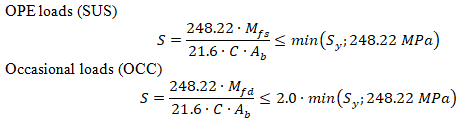
User-defined C and Ab values in flange
properties.
Sy values automatically retrieved from material database.

Property |
Description |
Axial Force |
Calculated axial force N on flange (+ tension, - compression), excluding pressure thrust |
Bending Moment |
Resultant bending moment M on flange
Mx, My - Bending moments in perpendicular planes through pipe axis |
Parameters |
Design
pressure for Peq methods |
Calculated |
Equivalent
pressure using selected method
|
Allowable |
Allowable
flange pressure
|
After analysis: Output > Flange Leakage

 or
or 