Learn more about PASS/START-PROF pipe stress analysis software
Cold spring reduces support loads, nozzle loads, displacements, and operating stresses in piping systems. However, it increases these values in the cold condition. Cold spring does not affect the stress range between operating and cold states.
For temperatures above the creep range, cold spring effects diminish due to creep and should not be considered in stress analysis.
Conclusion: Cold spring effectively reduces support loads in low-temperature piping systems.
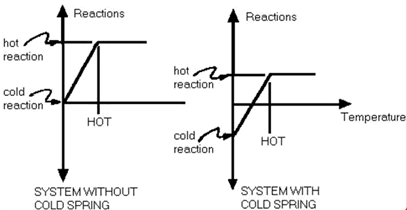
Cold spring is applied at nodal points. Conceptually, it involves cutting a pipe section of length dL, pulling the ends together, and rewelding. The cold spring property is defined by this length dL.
This example demonstrates cold spring application to a U-shaped expansion loop.
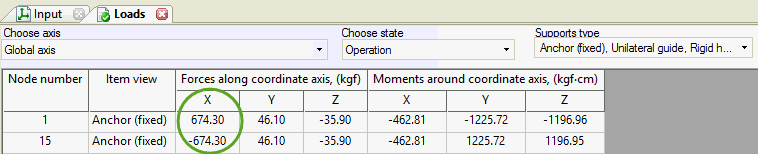
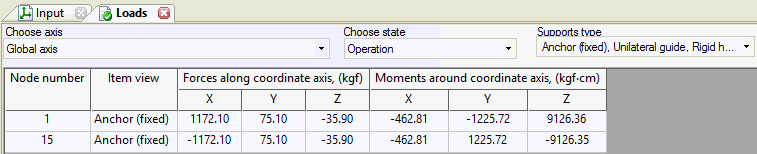
Without cold spring, fixed anchor loads in operating condition significantly exceed those in cold condition.
Example project file: ColdSpring.ctp


Calculate cold spring length dL using either method:

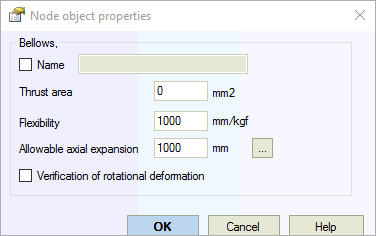

Apply cold spring at one node on either side of the U-loop. For symmetrical results considering friction effects, apply two cold springs (left and right) with dL = 23.6 mm / 2 = 11.8 mm each.
This approach equalizes fixed anchor loads between operating and cold conditions.
Example project file: ColdSpring2.ctp