Component
with known loss coefficient
To add
a new component with known loss coefficient,
click the button  of Components
toolbar, select the equipment type "Apparatus"
(or
use the corresponding item of "Insert
- Component - Equipment"
menu), and then in the Object Properties
window, select "Component with known loss coefficient"
as the hydraulic component type. Please note that the new
component is added to the project tree after the currently selected element.
Therefore, to add a new component after an existing one, select it in
the project tree or in the graphic window and add the new component. If
you need to add a new component to the beginning of a branch, select the
branch in the project tree and add the new component.
of Components
toolbar, select the equipment type "Apparatus"
(or
use the corresponding item of "Insert
- Component - Equipment"
menu), and then in the Object Properties
window, select "Component with known loss coefficient"
as the hydraulic component type. Please note that the new
component is added to the project tree after the currently selected element.
Therefore, to add a new component after an existing one, select it in
the project tree or in the graphic window and add the new component. If
you need to add a new component to the beginning of a branch, select the
branch in the project tree and add the new component.
Component with known loss coefficient
is used to model a wide variety of elements of a piping systems (most
often non-standard types of valves, fittings and other devices) for which
the values of their local resistance coefficients are known or can be
calculated/found in reference literature/passport characteristics.
After adding a component
with known loss coefficient, its characteristics will be displayed in
the Object Properties Window.
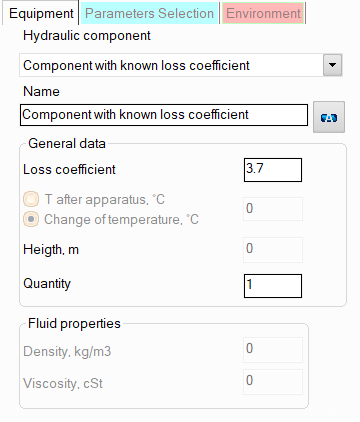
name -
by default, the name of
any piping component coincides with its type, but if necessary, the
name can be changed in this field. When changing the hydraulic component
type (when selecting different types of equipment), its name will
also change, but only if it has not been previously changed to another
manually. Specify the name that you would like to see for this element
in reports with calculation results. To display the name of a pipeline
element on the diagram, click the corresponding button to the right
of its name;
local resistance
coefficient ζ - the pressure drop Δp on this element will
be calculated using the Weisbach equation Δp=ζρw2/2,
where ρ and w are the density and velocity of the fluid,
respectively;
quantity -
this parameter is usually not used for resistances with known characteristics.
It is used for other pipeline elements (for example, for valves) when
modeling several identical elements. In this case, you can enter the
number of these elements in this field and at the calculation the
hydraulic resistance on this element will be multiplied by the specified
value. For a component with known
loss coefficient specifying "N resistances with coefficient
M" does not make sense, since you can simply specify the total
resistance coefficient N*M for it.
Please note that from a hydraulic
point of view, component with known loss
coefficient is considered as "point" (or "concentrated")
resistances, which have no length/width/height. Therefore,
if it is necessary to take into account the dimensions of such element
in the calculation to calculate and account for the friction losses, heat
losses and hydrostatic pressure drop that occur on it, they can be modeled
separately as a piece of pipe with the corresponding length and
orientation in space. However, this only
makes sense in cases where:
the
modeled element has really large size that cannot be neglected;
the modeled element is located in a vertical
or inclined plane relative to the vertical - in this case, it is important
to take into account the hydrostatic pressure drop that occurs on
it;
the modeled element is located in a closed
loop (so that the piping model looks correctly, without gaps).
In other cases, the dimensions of
component with known loss coefficient are usually neglected.