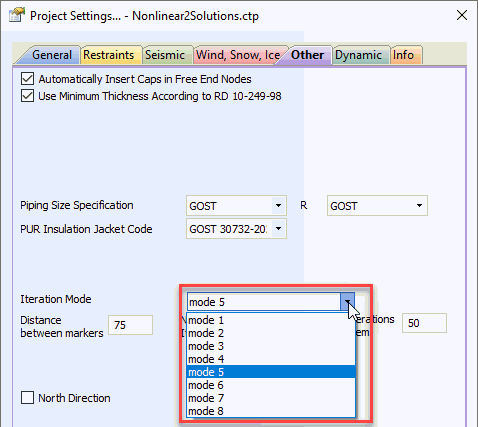
When analyzing piping systems that contain nonlinear elements (friction in supports, gaps, one-way constraints), engineers sometimes encounter an unexpected result: different iteration types (for example, iteration types 1-5) converge to different values of support loads, displacements, and stresses. This causes perplexity, as conventional linear problems imply a single, unique solution.
It is important to understand that nonlinear systems with friction, gaps, and one-way restraints can have multiple equilibrium states (solutions) under the same set of external loads. And all of these solutions are mathematically correct.
The simplest analogy is a cubic equation. It can have three different roots, and each of them will be a valid solution to the equation. Similarly, in mechanics: due to nonlinearities (for example, dry friction "locks" the system in different positions), the same model can exist in several stable equilibrium states.
Which specific state the system will reach in reality depends on the history and sequence of load application: the order in which springs were tightened, supports were displaced, cold pull was performed, gaps were taken up, and friction was "activated." In numerical simulation, we often do not fully account for this history. Therefore, different solution search algorithms (iteration types 1-5) may find different "correct" equilibrium states.
None of the obtained solutions can be a priori called "more correct" from a physical point of view. All of them are valid particular solutions that satisfy the equilibrium equations.
Since the exact load history is unknown, the standard engineering approach to systems with multiple states is as follows:
The observation that different iteration algorithms converge to different results is absolutely correct. This is not an error in the analysis, but a consequence of the complex physics of the system's behavior. Understanding this phenomenon is the key to correctly interpreting results and designing reliable piping systems.